
Football by the Numbers: Records That Have Shaped the Global Game
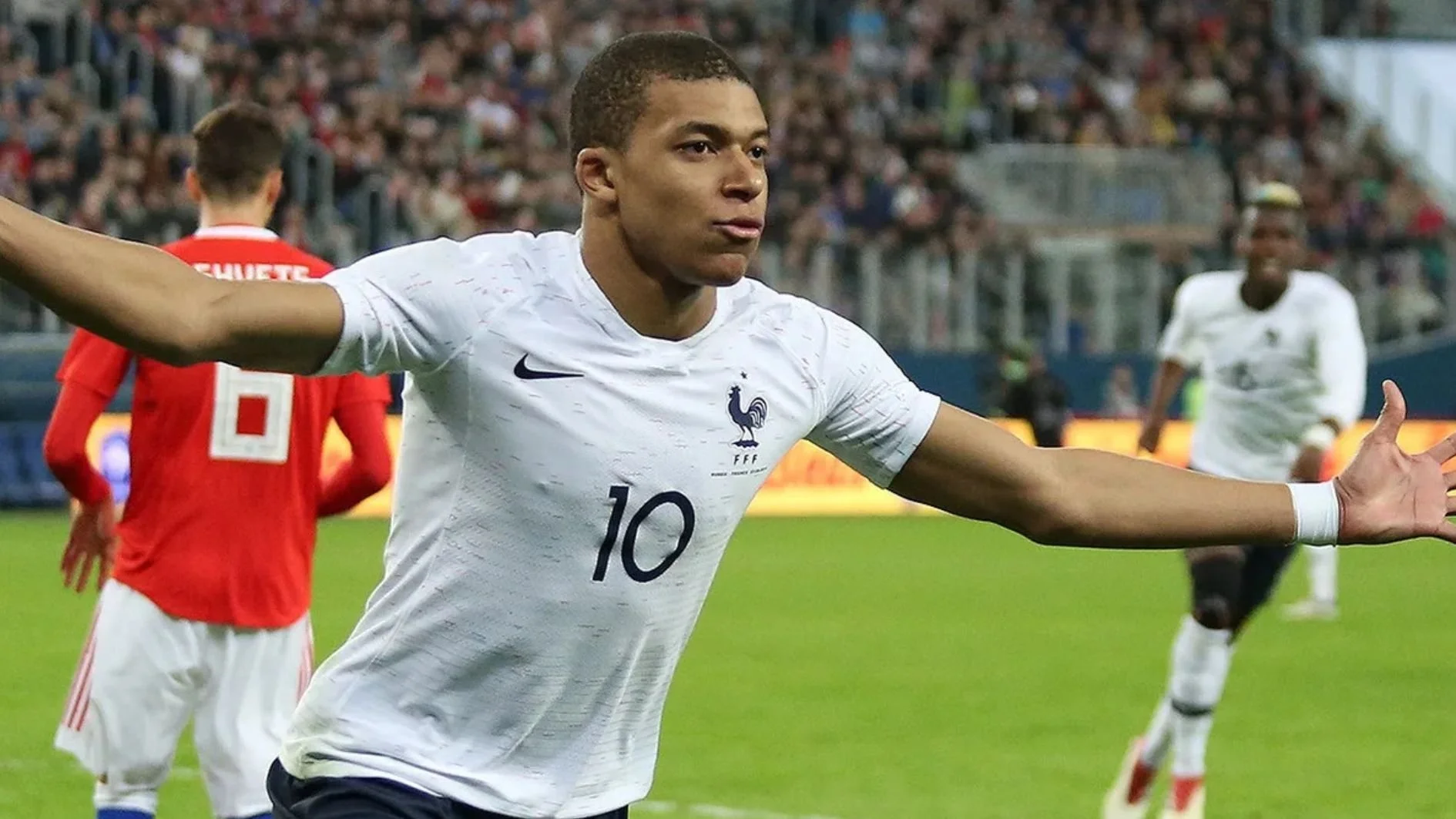
Photo: Kylian Mbappe celebrates a goal for France/ Wikimedia Commons, Kirill Venediktov, CC BY-SA 3.0, edited.
Last week, we looked at rugby through some of the records, rankings and statistics that have shaped the international game.
This week, we turn to football.
The scale is different, but the attraction of the numbers is much the same. Trophies tell us which nations dominated particular eras. Goals reveal players whose influence lasted across generations. Appearance records show extraordinary longevity, while some statistics come from a single afternoon that has remained unmatched for decades.
And 2026 has already rewritten several pages of the record book.
Kylian Mbappé became the highest goalscorer in Men's FIFA World Cup history. Lionel Messi extended the competition's appearance record to 34 matches. Spain won a second men's world title and became the first country simultaneously to hold FIFA's senior men's and women's world crowns.
Other records have survived far longer.
Brazil still have more men's World Cup titles than anyone else. The USA remain the most successful nation in Women's World Cup history. Christine Sinclair's international goals record remains untouched, while Pelé is still the only male player to have won three World Cups.
So, how well do you know football's biggest numbers?
Brazil still lead the Men's World Cup title count
Even after the 2026 FIFA World Cup, Brazil remain the most successful nation in the history of the men's competition with five titles.
Their victories came in 1958, 1962, 1970, 1994 and 2002, spanning very different generations of Brazilian football, from Pelé and Garrincha to Romário, Ronaldo and Rivaldo.
Germany and Italy follow with four titles each, while Argentina have three.
Spain's victory in 2026 changed the next tier of the ranking. Their second world title, following their first in South Africa in 2010, moved them alongside France and Uruguay on two.
Brazil also retain another extraordinary distinction: they are the only country to have appeared at every edition of the Men's FIFA World Cup, playing in all 23 tournaments staged between 1930 and 2026.
Winning five titles across almost a century of changing tactics, tournament formats and generations explains why Brazil's relationship with the World Cup remains unique.
Source: FIFA – Teams with the most World Cup titles
The USA set the standard in the Women's World Cup
The equivalent record in the women's game belongs to the United States, with four FIFA Women's World Cup titles.
The USA won the inaugural tournament in 1991, before adding titles in 1999, 2015 and 2019.
Germany are next with two, while Norway, Japan and Spain have each won once.
The American record is particularly significant because their four victories came across almost three decades, beginning with a tournament that was still establishing women's football on the global stage and extending into an era in which the Women's World Cup had become one of the largest sporting events in the world.
Spain are the current champions after winning the 2023 tournament, but the USA remain the historical benchmark.
Source: FIFA – Who has won the most Women's World Cups?
Spain made football history in 2026 without playing a women's final
Spain's World Cup victory in July produced a record that reaches beyond the men's tournament itself.
By defeating Argentina 1-0 after extra time in the 2026 final, Spain became the first country ever to simultaneously hold FIFA's senior men's and women's world titles.
The women's national team had won its first World Cup in Australia and New Zealand in 2023. Three years later, the men's team added the 2026 trophy.
No nation had previously held both titles at the same time.
It is a particularly interesting record because it says something broader than the result of one competition. Men's and women's football operate through different teams, coaching structures and competitive cycles, yet Spain reached the top of both games within the same period.
Source: FIFA – Spain complete an unprecedented global double
Kylian Mbappé: 22 World Cup goals and a record rewritten in 2026
Until June 2026, the benchmark for Men's World Cup goals had stood at 16, set by Germany's Miroslav Klose.
By July, that record belonged to Kylian Mbappé, and the new figure was 22.
The French forward entered the tournament with 12 World Cup goals. He then scored ten times in eight matches in North America, winning the Golden Boot for the second consecutive World Cup.
His final two goals came in the extraordinary 6-4 defeat to England in the third-place play-off, taking him past Lionel Messi, who finished his World Cup career with 21.
Mbappé's total is even more striking when broken down by tournament: four goals in 2018, eight in 2022 and ten in 2026.
And he is still only 27.
Assuming he remains internationally active, the record may therefore continue moving before another player has the opportunity to catch it.
Source: FIFA – Kylian Mbappé's World Cup records and 22 goals
Lionel Messi: nobody has played more World Cup matches
While Mbappé took the goals record, Lionel Messi extended another record considerably during the same tournament.
The Argentine finished his World Cup career with 34 appearances across six editions.
Cristiano Ronaldo is second with 27, followed by Lothar Matthäus on 25 and Miroslav Klose on 24.
Messi first played at a World Cup as an 18-year-old in Germany in 2006. Twenty years later, he appeared in the 2026 final against Spain.
His longevity is only part of the story.
Messi also holds the record for the most victories by an individual player at Men's World Cups, with 23, having overtaken Klose during the 2026 tournament.
Six World Cups, three finals, one title and 34 matches create a statistical record that would have seemed extraordinarily difficult to imagine when Matthäus' old mark of 25 games appeared almost untouchable.
Source: FIFA – Players with the most World Cup appearances
Source: FIFA – Players with the most World Cup victories
Cristiano Ronaldo: 146 international goals for Portugal
Some records extend beyond the World Cup.
Cristiano Ronaldo is the highest goalscorer in the history of men's international football, with 146 goals for Portugal as of October 2026.
He surpassed Iran's Ali Daei, whose previous record stood at 108 officially recognised international goals, in September 2021 and has continued to increase the distance between himself and the rest of the ranking.
Lionel Messi finished his Argentina career on 126 goals, while India's Sunil Chhetri retired with 95.
Ronaldo also holds the men's record for international appearances, with 234 Portugal caps.
There is another unusual longevity statistic attached to his career: having failed to score in his first two international appearances in 2003, Ronaldo subsequently scored for Portugal in 23 consecutive calendar years, from 2004 through 2026.
He also became the first male player to score at six different World Cups.
Few football records depend so heavily on staying relevant for more than two decades.
Source: UEFA – Cristiano Ronaldo: all-time leading scorer in men's international football
Christine Sinclair went far beyond the men's international goals record
Ronaldo leads men's international football, but the overall figure is even higher in the women's game.
Canada's Christine Sinclair scored 190 international goals, the recognised record in senior international football.
She achieved the total across a career spanning more than two decades, representing Canada at six Women's World Cups and four Olympic Games.
For perspective, Sinclair finished 44 goals ahead of Ronaldo's current men's record of 146.
Her international career also included Olympic gold at Tokyo 2020 and bronze medals at London 2012 and Rio 2016.
Sinclair's record illustrates why men's and women's statistics should not simply be placed in separate conversations. Some of the largest numbers in international football history belong to women.
Source: FIFA – Christine Sinclair and the international goals record
Kristine Lilly: 354 international appearances
There is an even larger gap when the discussion turns from goals to appearances.
The most-capped footballer in senior international history is Kristine Lilly, who played 354 times for the United States.
Her international career began in 1987 while she was still at high school and extended across four decades.
Lilly became the first footballer to reach 200 international appearances and continued for more than another 150.
She appeared at five Women's World Cups between 1991 and 2007, winning the tournament twice, in 1991 and 1999.
Her 354 caps remain a remarkable measure of longevity. Even Ronaldo's record-breaking 234 appearances in men's football leave a difference of 120 matches.
Source: FIFA – The female footballers with more than 300 caps
Marta: 17 goals and the Women's World Cup scoring record
Before Mbappé and Messi rewrote the overall men's scoring table in 2026, one player had already shown what long-term World Cup goalscoring could look like.
Brazil's Marta scored 17 goals at Women's World Cups, the record for the competition.
She scored those goals across five tournaments between 2003 and 2019 and reached her peak in 2007, when she scored seven times as Brazil reached the final.
For several years, her 17 goals also meant she had scored more World Cup goals than any male or female footballer.
Miroslav Klose's men's record was 16.
The events of 2026 changed the overall comparison, with Mbappé reaching 22 and Messi 21, but Marta remains the highest-scoring player in Women's World Cup history.
She also scored at five separate World Cups, another indication of how long she remained influential at the highest level.
Source: FIFA – Marta's 17 Women's World Cup goals
Just Fontaine and Michelle Akers: when one tournament was enough to make history
Career totals usually favour longevity.
Single-tournament records tell a different story.
France's Just Fontaine scored 13 goals at the 1958 Men's World Cup, a record that remains untouched almost seven decades later.
Even Mbappé's extraordinary ten goals in 2026 fell three short.
Fontaine scored his 13 in only six matches. His tournament included a hat-trick against Paraguay, braces against Yugoslavia and Northern Ireland and four goals against West Germany in the third-place play-off.
The equivalent Women's World Cup record belongs to the USA's Michelle Akers, who scored ten goals in 1991.
Five of them came in one match, a 7-0 victory over Chinese Taipei, before Akers scored twice in the final against Norway as the USA became the first Women's World Cup champions.
Two tournaments separated by 33 years, two records that still stand.
Sources:
FIFA – Just Fontaine's 13-goal World Cup record
FIFA – Michelle Akers' Women's World Cup record
10-1 and 13-0: the biggest World Cup victories
Some records are remembered because the numbers almost look incorrect.
In Men's World Cup history, the largest winning margin is nine goals, and it has happened three times.
Hungary beat Korea Republic 9-0 in 1954 and El Salvador 10-1 in 1982, while Yugoslavia defeated Zaire 9-0 in 1974.
Hungary's 10-1 result remains the highest number of goals scored by one team in a Men's World Cup match.
The women's record is even larger.
At the 2019 Women's World Cup, the USA defeated Thailand 13-0, the biggest winning margin in the competition's history.
Alex Morgan scored five times, equalling Michelle Akers' record for the most goals by one player in a Women's World Cup match.
The USA would go on to win the tournament, scoring 26 goals across seven matches.
Sources:
FIFA – Record winning margins at the Men's World Cup
FIFA – USA's record 13-0 victory over Thailand
Eleven seconds: the fastest Men's World Cup goal
Not every record requires years of consistency.
Sometimes, eleven seconds are enough.
Türkiye's Hakan Şükür scored the fastest goal in Men's World Cup history just 11 seconds into the 2002 third-place play-off against Korea Republic.
Türkiye eventually won the match 3-2.
The record remains comfortably ahead of the next fastest: Václav Mašek scored after 15 seconds for Czechoslovakia against Mexico in 1962.
Only 13 Men's World Cup goals have ever been scored inside the opening minute.
For most players, merely touching the ball within 11 seconds of kick-off would be unremarkable. Şükür had already put it in the net.
Source: FIFA – Fastest goals in World Cup history
Pelé: the only man with three World Cup titles
Team records and individual records occasionally overlap.
Brazil won three World Cups during Pelé's international career, and the Brazilian was part of all three victorious squads: 1958, 1962 and 1970.
He remains the only male player to have won three FIFA World Cups.
The first came when he was only 17. Pelé scored in the quarter-final, produced a hat-trick against France in the semi-final and scored twice in Brazil's 5-2 final victory over Sweden.
Twelve years later, he was at the heart of another Brazilian side widely regarded as one of the greatest international teams ever assembled, culminating in a 4-1 victory over Italy in the 1970 final.
Many legendary players have won the World Cup twice.
Nobody has matched three.
Source: FIFA – Pelé's unique three World Cup titles
Real Madrid: 15 European Cups
World football records are not restricted to national teams.
In European club football, one number has stood apart for decades.
Real Madrid have won the European Cup and UEFA Champions League 15 times, more than twice as many as their closest rival, AC Milan.
Madrid won the first five editions of the competition between 1956 and 1960, establishing a relationship with the European Cup almost from the moment the tournament was created.
Their success later stretched into very different eras, from the team of Alfredo Di Stéfano and Ferenc Puskás to the squads built around Cristiano Ronaldo, Luka Modrić, Toni Kroos and Karim Benzema.
As of 2026, 24 clubs from ten countries have been European champions.
None are close to Madrid's total.
Source: UEFA – European Cup and Champions League winners
OL Lyonnes: eight Women's Champions League titles
The dominant club in European women's competition is OL Lyonnes, formerly known simply as Lyon.
The French club have won the UEFA Women's Champions League eight times.
Their period of dominance included five consecutive titles between 2016 and 2020.
That sequence matched the five European Cups won consecutively by Real Madrid's men's team between 1956 and 1960.
Barcelona have become the strongest challenger in recent seasons and won their fourth title in 2026, moving level with Frankfurt in second place on the all-time list.
Lyon's eight, however, still leave a considerable gap.
Source: UEFA – OL Lyonnes and their Women's Champions League records
Cristiano Ronaldo and Ada Hegerberg: Europe's club goalscoring benchmarks
The men's Champions League has another record with a strong Portuguese connection.
Cristiano Ronaldo scored 140 UEFA Champions League goals in 183 appearances, making him the competition's all-time leading scorer.
His closest historical rival is Lionel Messi.
Ronaldo also holds the record for most goals in a single Champions League campaign, with 17 for Real Madrid in 2013/14, and scored 67 times in knockout matches.
In the women's competition, the all-time scoring record belongs to Norway's Ada Hegerberg, who had reached 69 UEFA women's club competition goals by the end of the 2025/26 season.
Hegerberg overtook former record holder Anja Mittag in 2019 and continued to increase her lead while representing Lyon.
Different competitions and different eras, but both records illustrate the same quality: producing goals repeatedly at the highest level of European club football.
Sources:
UEFA – Cristiano Ronaldo's Champions League records
UEFA – Women's Champions League all-time top scorers
Football records rarely stay still
Last week's rugby records included numbers that have survived decades. Football tells a similar story, but 2026 also demonstrated how quickly a record book can change.
Miroslav Klose began the year as the highest-scoring player in Men's World Cup history. Within weeks, Lionel Messi had passed him, only for Kylian Mbappé to finish the tournament ahead of them both.
Messi extended a World Cup appearance record that had already belonged to him. Spain added a second star and simultaneously entered the history books for holding both senior FIFA world titles. Meanwhile, records established by Pelé, Just Fontaine and Michelle Akers decades ago remain intact.
That is what makes sporting records interesting.
They allow us to compare eras that otherwise have very little in common. Football has changed tactically, physically and commercially beyond recognition since the first Men's World Cup in 1930 and the first Women's World Cup in 1991.
The numbers provide a thread connecting those different periods.
And every tournament creates another opportunity for someone to change them.