
Legendary Sports Moments Throughout History: Why Some Memories Outlive the Score
Every generation has sporting moments it never forgets.
Sometimes they are defined by a record. Sometimes by a comeback, a gesture, an upset or a single image that seems to hold more meaning than the result itself. A runner crossing a line. A player lifting a trophy. A team defeating impossible odds. An athlete continuing even when victory is no longer possible.
These moments become legendary not only because of what happened, but because of how people felt while watching them.
Sport is full of numbers: times, scores, medals, rankings and statistics. Yet the moments that remain in collective memory often carry something beyond measurement. They tell us something about courage, pressure, identity, belief, social change or the limits of what people thought was possible.
This is not a definitive ranking of the greatest sports moments in history. It is a look at the kind of moments that explain why sport continues to matter so deeply.
When Sport Redefines What Is Possible
Some legendary moments endure because they change the boundaries of belief.
On 6 May 1954, Roger Bannister became the first person to run a mile in under four minutes, recording 3:59.4 at Iffley Road in Oxford. Before that day, the four-minute mile had become more than a sporting target. It was a psychological barrier. Once Bannister broke it, the impossible suddenly became possible, and the way people spoke about human limits changed.
More than two decades later, at the Montreal 1976 Olympic Games, Nadia Comăneci produced another moment that seemed almost unreal. At just 14 years old, she became the first gymnast in Olympic history to receive a perfect 10.0. The scoreboard famously displayed 1.00 because it had not been built to show a perfect ten. It was a technical detail, but also a symbol: the system itself had not been prepared for perfection.
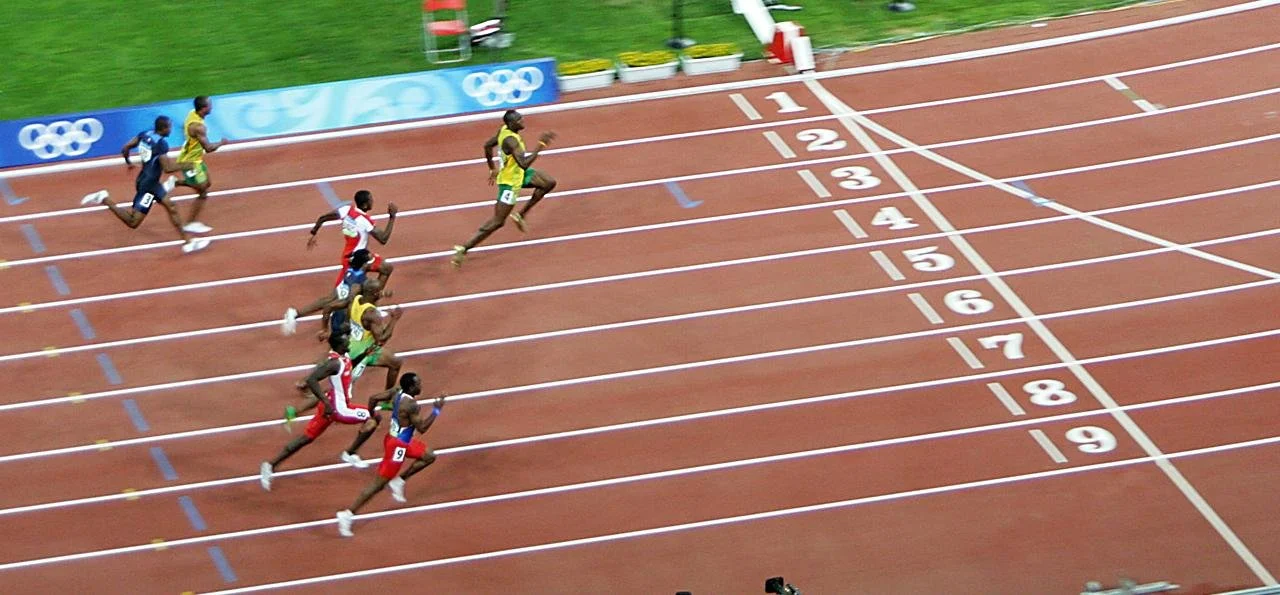
Then came Usain Bolt in Beijing in 2008. His 100m Olympic final was not only memorable because he won. It was memorable because of the way he won. Bolt crossed the line in a world record time of 9.69 seconds, visibly easing up before the finish and celebrating before the race was even complete. The performance felt less like a narrow athletic victory and more like a public announcement that sprinting had entered a different era.
These moments matter because they stretch the imagination. They make spectators ask a simple question: if that is possible, what else might be?
When the Result Carries More Than Sport
Other moments become legendary because the sporting action is inseparable from the world around it.
Jesse Owens’ four gold medals at the Berlin 1936 Olympic Games remain one of the most powerful examples. Owens won the 100m, 200m, long jump and 4x100m relay in an Olympics used by Nazi Germany as a stage for political propaganda. His performances were extraordinary in athletic terms, but their lasting meaning came from the context in which they happened.
In 1973, Billie Jean King defeated Bobby Riggs in the “Battle of the Sexes”, a tennis match watched by tens of millions around the world. It was entertainment, spectacle and sport, but it was also part of a wider conversation about gender equality, respect and visibility in sport. King’s victory became a cultural moment because it spoke far beyond tennis.
The 1995 Rugby World Cup final in South Africa carried similar symbolic weight. When Nelson Mandela presented the trophy to Springboks captain François Pienaar, wearing a Springbok jersey, the image became one of the defining sporting symbols of post-apartheid South Africa. South Africa’s victory over New Zealand mattered as a rugby result, but the moment is remembered because it seemed to represent something much larger: unity, reconciliation and the possibility of shared national identity.
Cathy Freeman’s 400m gold medal at Sydney 2000 also belongs in this category. After lighting the Olympic cauldron at the opening ceremony, Freeman carried enormous expectation into the final and won in front of a home crowd. As an Indigenous Australian athlete competing at a home Olympics, her victory became one of the most significant moments in Australian sporting history.
In all these cases, sport became a stage where society could see itself more clearly.
When Underdogs Rewrite the Story
Few things capture the imagination like an unexpected victory.
In football, the 1950 FIFA World Cup remains inseparable from the “Maracanazo”, when Uruguay defeated Brazil 2-1 at the Maracanã in Rio de Janeiro. Brazil were widely expected to win, and the stadium was filled with belief before the match began. Uruguay’s victory was not just an upset. It became part of football folklore because it showed how quickly expectation can turn into shock, and how one result can live inside a nation’s memory for decades.
Thirty years later, at the Lake Placid 1980 Winter Olympics, the United States ice hockey team defeated the Soviet Union 4-3 in what became known as the “Miracle on Ice”. The Soviet team had dominated international hockey, while the American team was made up largely of college players. The result became one of the most famous upsets in Olympic history, remembered not only for the scoreline but for the emotional and political context of the Cold War era.
In a very different setting, Leicester City’s 2015/16 Premier League title became one of modern sport’s great underdog stories. Starting the season as 5,000-1 outsiders, they became English champions for the first time. What made the achievement so powerful was not one single match, but the slow realisation across an entire season that the impossible was not fading away. Week after week, expectation waited for Leicester to collapse. Week after week, they stayed alive.
Underdog stories endure because they protect one of sport’s most important promises: that outcomes are never fully written in advance.
When Defeat Becomes Unforgettable
Not every legendary sports moment is about winning.
At the Barcelona 1992 Olympic Games, British runner Derek Redmond tore his hamstring during the 400m semi-final. His chance of reaching the final was gone, but he continued towards the finish line. His father, Jim Redmond, came onto the track and helped him complete the race. It was not a medal moment, but it became one of the most emotional images in Olympic history.
The reason people remember it is clear. It showed that sport is not only about victory, but about effort, dignity, love and the refusal to let a moment end only in pain.
These are the moments that remind us why sport can feel so human. A result may decide the competition, but it does not always decide the meaning.
Why Legendary Moments Last
Legendary sports moments are rarely remembered for one reason alone.
They last because they combine performance with emotion. They happen at the right time, in the right context, under pressure that people can understand even if they have never competed at that level.
A record matters, but the story around the record matters too.
A trophy matters, but the journey towards it often matters more.
A victory matters, but sometimes a defeat can reveal something even stronger.
That is why these moments continue to be watched, discussed and shared years after they happened. They offer more than nostalgia. They remind us that sport can still surprise us, move us and occasionally change the way we see what people are capable of doing.
In the end, the most legendary sports moments are not simply those that appear in history books.
They are the ones people continue to feel.
Long after the final whistle, the finish line or the scoreboard.
Sources:
https://worldathletics.org/news/news/first-four-minute-mile-50th-celebrations
https://www.youtube.com/watch?v=2tyEL6QS1hU
https://www.iwm.org.uk/history/second-world-war/holocaust/1936-olympics
https://www.fifa.com/en/tournaments/mens/worldcup/articles/uruguay-brazil-1950-maracanazo
https://www.billiejeanking.com/
https://www.olympics.com.au/olympians/cathy-freeman/
https://www.history.com/this-day-in-history/february-22/u-s-hockey-team-makes-miracle-on-ice