
Portuguese Athletes Making a Global Impact in 2026: Achievements, Records and Careers Shaping the Year
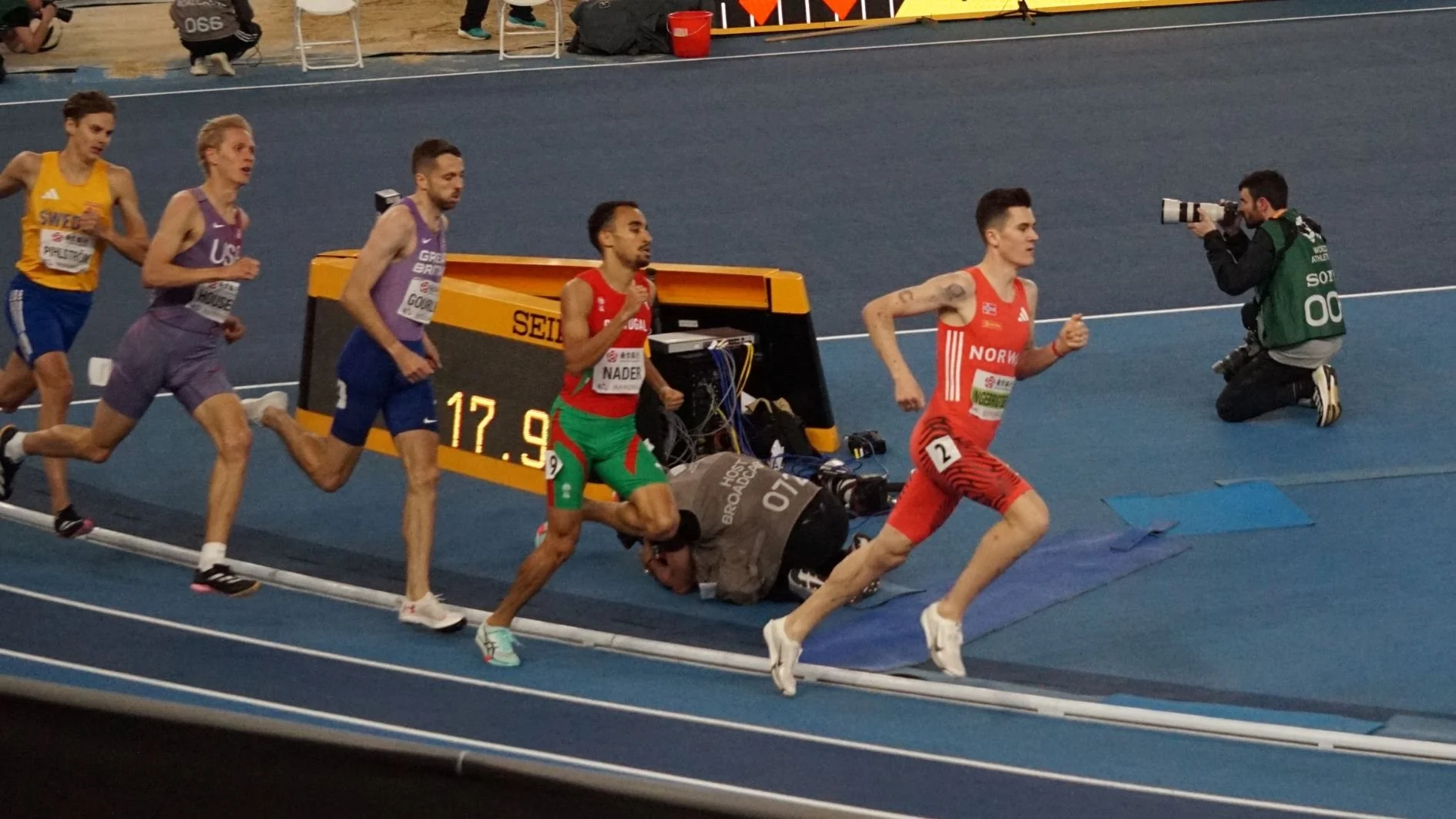
Photo: 三猎 / Wikimedia Commons, CC BY-SA 4.0. Cropped/adapted from the original.
There was one day in March that captured the strength of Portuguese sport particularly well. On 22 March, at the World Athletics Indoor Championships in Toruń, Agate de Sousa and Gerson Baldé became world champions in the long jump, while Isaac Nader claimed silver in the 1500 metres. Three Portuguese athletes, three global medals and two world titles, all within a matter of hours.
Yet Portugal’s sporting year has stretched far beyond that moment. Fernando Pimenta returned from the Canoe Sprint World Championships with two world titles, Afonso Eulálio spent nine days in the pink jersey at the Giro d’Italia, Iúri Leitão added a historic European title to an already remarkable track cycling career, Vitinha was named Player of the Match in the Champions League final, Cristiano Ronaldo reached his sixth World Cup, and Gilberto Filipe became the first three-time individual world champion in the history of Working Equitation.
What makes 2026 particularly interesting is not simply the number of results. It is the range of sports, the diversity of backgrounds and the different stages of the athletes’ careers.
This is not a ranking of Portugal’s “best” athletes. It is a selection of Portuguese sportspeople who, by mid-September, had clear and measurable reasons to stand out on the international stage in 2026.
Agate de Sousa: a first world title at exactly the right moment
Agate de Sousa arrived at the World Indoor Championships already well beyond the status of emerging talent. She had jumped 6.97 metres in Madrid in February, entered Toruń as one of the leading athletes of the season and produced her decisive jump when it mattered most.
Her 6.92 metres in the fifth round was enough to secure the world title, five centimetres ahead of Italy’s Larissa Iapichino. It was Agate’s first medal at a global championship, and it was gold.
The result becomes even more significant when placed within the speed of her rise in Portuguese colours. Born in São Tomé and Príncipe, she became eligible to represent Portugal internationally in May 2024. That same year, she won bronze at the European Championships, before taking gold at the World University Games in 2025.
By 2026, she was no longer simply reaching major finals. She was winning them.
Her outdoor season reinforced that position, even without another medal. At the European Championships in Birmingham, she finished fourth with 6.96 metres, only two centimetres short of bronze, before placing sixth at the inaugural World Athletics Ultimate Championship in Budapest.
She did not reproduce the high point of Toruń every time she competed, but she continued to appear consistently in the finals that bring together the world’s leading long jumpers.
Sources:
World Athletics – Women’s long jump report, Toruń
World Athletics – Agate de Sousa profile
Gerson Baldé: from 8.20 metres to 8.46 and a world title
While Agate de Sousa’s victory confirmed a progression that had already been gathering momentum, Gerson Baldé’s world title immediately changed the scale of his international profile.
Baldé won the men’s long jump in Toruń with 8.46 metres, setting a new Portuguese record and defeating athletes already established among the strongest long jumpers in the world.
The leap in performance was striking. One year earlier, his personal best stood at 8.20 metres. In 2025, he had finished fourth at the European Indoor Championships and eighth at the World Championships. Within a few months, the distance between reaching a global final and winning one had disappeared.
His outdoor season suggested that Toruń was not an isolated performance. At the European Championships in Birmingham, Baldé again came close to the podium, finishing fourth with 8.18 metres, and he later competed at the World Athletics Ultimate Championship.
For the 26-year-old, 2026 represents above all a change in status. He entered the year as a strong European jumper on the rise and leaves it as a world champion whose presence now matters whenever a major long jump competition begins.
Sources:
World Athletics – Men’s long jump results, Toruń
Sporting CP – Gerson Baldé world title
Isaac Nader: following a world title with another global medal
Isaac Nader began 2026 from a very different position. He had already achieved what Agate de Sousa and Gerson Baldé were pursuing: he entered the year as the reigning 1500-metre world champion outdoors, following his victory in Tokyo in 2025.
The challenge was therefore no longer to break through, but to remain at that level.
He responded quickly. In Toruń, Nader won silver in the 1500 metres in 3:40.06, finishing behind Spain’s Mariano García. Before the World Indoor Championships, he had already used the indoor season to rewrite several Portuguese records, including 3:32.44 for 1500 metres, 1:45.05 for 800 metres and 7:38.05 for 3000 metres.
His outdoor campaign was less straightforward. At the World Athletics Ultimate Championship in Budapest, he finished 12th in the 1500-metre final.
That result does not diminish what he achieved earlier in the season. Instead, it places his 2026 in context. Remaining among the world’s leading middle-distance runners does not mean winning continuously. In Nader’s case, it means carrying the level that made him world champion into another season and continuing to compete as one of the internationally recognised names in the event.
Sources:
World Athletics – 1500m final, Toruń
World Athletics – Isaac Nader profile
Pedro Pichardo: staying at the top is an achievement in itself
Pedro Pablo Pichardo no longer needs a breakthrough season to establish his reputation. An Olympic champion, world champion and multiple Diamond League winner, he entered 2026 with a record that had already secured his place among the finest triple jumpers of his generation.
What makes his season notable is precisely his ability to remain at that level.
At 33, Pichardo continued to compete at the top of the world rankings, won Diamond League meetings in Doha and Lausanne and claimed silver at the European Championships in Birmingham with a jump of 17.76 metres.
Gold went to Italy’s Andy Díaz Hernández with 18.15 metres, but the Portuguese athlete was once again on a continental podium and remained one of the central figures in international triple jump throughout the season.
His career helps explain the significance of that longevity. After previously competing for Cuba, Pichardo became eligible to represent Portugal in 2019. Olympic gold in Tokyo followed, along with world titles and season after season beyond the 17-metre mark.
In 2026, his relevance comes not from discovery, but from durability. In an event where a new generation of athletes continues to emerge, Pichardo remains firmly among the competitors shaping the discipline.
Sources:
World Athletics – Pedro Pichardo profile
Diamond League – Pedro Pichardo
Fatoumata Binta Diallo: a Portuguese hurdler now established among the elite
The rise of Fatoumata Binta Diallo may be one of the less obvious stories in this group, but her 2026 results make her difficult to overlook.
At the European Championships in Birmingham, Diallo won bronze in the 400 metres hurdles with 53.55 seconds, then a Portuguese record. She became the first Portuguese athlete to reach the European podium in the event.
Only two weeks later, she lowered the national record again, running 53.30 seconds at the Zurich Diamond League. By mid-September, she was ninth in the World Athletics rankings.
Her path to this level began far from the biggest international stadiums. Born in Guinea, Diallo moved to Portugal at the age of 12 and first took part in cross-country through school sport in the Algarve. It was there that she met coach Paulo Murta and athletics gradually became more than a school activity.
She competed for Clube Oriental de Pechão before later joining Benfica, while progressively specialising in the hurdles.
In September, she missed the final of the World Athletics Ultimate Championship in Budapest by just six hundredths of a second. That consistency around the top positions explains her prominence in 2026. Diallo is no longer arriving at major championships as an outsider hoping to cause an upset. She is competing inside the group expected to challenge for finals and medals.
Sources:
Portuguese Athletics Federation – Fatoumata Diallo wins European bronze
World Athletics – Fatoumata Diallo profile
Fernando Pimenta: two world titles in one weekend at 37
Some careers are long. Others seem to keep finding new ways to remain significant. Fernando Pimenta clearly belongs to the second category.
At the Canoe Sprint World Championships in Poznań, the Portuguese paddler won both the K1 1000 metres and K1 5000 metres.
In the Olympic-distance K1 1000, he finished in 3:24.39 to secure the fourth world title of his career in the event. The following day, he won the K1 5000, adding a third world title over that distance. At 37, he also became the oldest world champion in the history of the men’s K1 1000.
This was not a sudden peak in August. Pimenta had already completed the 1000/5000 double at the World Cup in Szeged in May and repeated it in Montreal in July.
He arrived at the World Championships after several months of proving that he could still dominate races requiring very different qualities.
His career began at the age of 11 at Clube Náutico de Ponte de Lima. At London 2012, together with Emanuel Silva, he won silver in the K2 1000 metres, Portugal’s first Olympic medal in canoe sprint. A bronze medal in the K1 1000 followed at Tokyo 2020.
More than a decade after his first Olympic medal, 2026 is not functioning as a nostalgic extension of Pimenta’s career. It is producing some of his finest competitive results.
Sources:
Portuguese Olympic Committee – Fernando Pimenta world champion in K1 1000
International Canoe Federation – Fernando Pimenta profile
Iúri Leitão: from Olympic gold to a European title Portugal had never won
The Olympic gold medal in Paris 2024 could easily have turned everything that followed into a footnote in Iúri Leitão’s career. Instead, he has continued to add new achievements.
In February 2026, Leitão won the omnium at the European Track Championships, finishing with 140 points and giving Portugal its first elite European title in an Olympic track cycling discipline.
The following day, he added silver in the madison alongside Diogo Narciso.
The achievement fits into a career that has moved rapidly from promising to historic for Portuguese track cycling. Leitão had already been world champion in the omnium in 2023 and, at the Paris Olympics, won silver in the same event before becoming Olympic champion in the madison with Rui Oliveira.
The European title in 2026 filled one of the few major gaps remaining in his track record.
His international importance also comes from his versatility. Scratch, omnium, madison and points races demand tactical awareness, speed, endurance and the ability to read a race as it develops. Leitão has built his place among the world’s best precisely through that combination.
Sources:
Portuguese Olympic Committee – Iúri Leitão European omnium champion
RTP – Iúri Leitão European champion
Afonso Eulálio: nine days in pink changed the scale of his career
At the start of the 2026 Giro d’Italia, Afonso Eulálio was not the Portuguese cyclist attracting the greatest attention. By the end of the race, he had emerged as one of the revelations of the edition.
He finished second on stage five and took the maglia rosa, becoming only the third Portuguese rider to lead the Giro after Acácio da Silva and João Almeida.
Eulálio kept the pink jersey for nine days.
When the race finished in Rome, he was sixth in the general classification and winner of the white jersey as the best young rider.
The scale of that performance becomes clearer when looking at the speed of his rise. Born in Figueira da Foz, Eulálio had been racing in Portugal’s continental peloton and gained attention at the 2024 Volta a Portugal, where he wore the yellow jersey for six days.
Bahrain Victorious signed him for the WorldTour at the end of that season. In 2025, he made his Giro debut and later finished ninth in the road race at the World Championships. One year later, he was competing near the front of a Grand Tour.
The pink jersey gave him international visibility. Sixth overall demonstrated that he could sustain that level over three weeks.
That distinction matters. Some riders gain prominence for a few days because of the dynamics of a race. Eulálio finished the Giro among the strongest riders in the overall classification.
Sources:
Giro d’Italia – Stage 5 and maglia rosa
Bahrain Victorious – Eulálio wins the white jersey
Vitinha: the Portuguese midfielder who controlled the Champions League final
Football produced several Portuguese players worthy of international attention in 2026. Vitinha has one particularly strong argument because one of his finest performances came on the biggest stage in European club football.
In the UEFA Champions League final on 30 May, the Paris Saint-Germain midfielder was named Player of the Match by UEFA.
The technical observers highlighted his control of midfield, ability to dictate the tempo and influence over the way PSG managed the match as the French club won a second consecutive Champions League title.
His season went beyond one performance. Vitinha was also selected in the official Champions League Team of the Season and, in September, appeared among the 30 nominees for the Ballon d’Or.
Nuno Mendes and João Neves were also among the Portuguese players nominated, reflecting the international prominence of PSG’s Portuguese contingent in 2026.
For Vitinha, the path is equally revealing. Developed at FC Porto, he spent a season on loan at Wolverhampton before returning to Portugal and establishing himself in Porto’s first team.
His move to Paris gave him greater international exposure, but the following seasons transformed him from a high-level midfielder into one of the players around whom a European champion structures its game.
Sources:
UEFA – Vitinha named Player of the Match in the Champions League final
UEFA – Champions League Team of the Season
Cristiano Ronaldo: a sixth World Cup and another record once considered almost impossible
In 2026, Cristiano Ronaldo remained at the centre of global attention for reasons different from those that defined the most dominant years of his career.
At 41, the World Cup became as much a story of longevity as performance.
By scoring against Uzbekistan, Ronaldo became the first male footballer to score at six different FIFA World Cups.
He also reached ten World Cup goals, moving past Eusébio as Portugal’s leading scorer in the competition.
Portugal were eventually eliminated by Spain in the round of 16, in what became Ronaldo’s final World Cup appearance. During the tournament, he also became the second-oldest player to score in a World Cup and the oldest player to find the net in a knockout match.
By July, UEFA listed him on 146 goals in 233 appearances for Portugal, both records in men’s international football.
After more than two decades spanning Sporting CP, Manchester United, Real Madrid, Juventus, Al Nassr and the Portuguese national team, Ronaldo’s prominence in 2026 is no longer measured in the same way as it was at 25 or 30.
What continues to keep him in the global conversation is his ability to extend records into territory that would have seemed highly improbable only a few years ago.
Sources:
FIFA – Cristiano Ronaldo scores at a sixth World Cup
UEFA – Cristiano Ronaldo international records
Gilberto Filipe: a three-time world champion who deserves attention beyond equestrian sport
Not every world title receives the same level of media coverage, but visibility should not be confused with competitive significance.
On 12 September, Gilberto Filipe became the first rider in the history of Working Equitation to win three individual world titles.
Riding Morante, he won both the Dressage and Maneability tests at the World Championship in Jerez de la Frontera and finished first overall.
He had previously been world champion in 2018 and 2022.
Portugal also won the team competition in an edition that brought together 74 horse-and-rider combinations from 22 countries, the largest participation ever recorded at a World Championship in the discipline.
The third title gives another dimension to Gilberto Filipe’s career. This was not a one-off victory in a sport where Portugal traditionally performs well. It represents eight years at the highest international level and a record that no other rider had previously achieved.
Leaving him out of a discussion about Portuguese athletes making a global impact in 2026 simply because Working Equitation receives less mainstream coverage would mean confusing fame with sporting performance.
Sources:
Portuguese Olympic Committee – Portugal and Gilberto Filipe world champions
Presidency of the Portuguese Republic – Gilberto Filipe’s world title
What 2026 is revealing about Portuguese sport
These athletes have very different stories, and that may be the most interesting point of all.
Fernando Pimenta has built his season on longevity and endurance. Agate de Sousa and Gerson Baldé made major competitive breakthroughs. Fatoumata Diallo moved closer to the very top level in one of athletics’ most demanding events. Iúri Leitão continues to turn track cycling into an area of Portuguese international success. Afonso Eulálio climbed the hierarchy of a Grand Tour far faster than many expected. Vitinha became central to the biggest club competition in European football. Cristiano Ronaldo pushed footballing longevity into unprecedented territory. Gilberto Filipe once again demonstrated Portugal’s strength in Working Equitation.
There is no single measure that can fairly compare a Canoe Sprint World Championship, a Champions League final, the Giro d’Italia or a Working Equitation World Championship. The media reach is different, just as the competitive structures of each sport are different.
There is, however, one common and verifiable thread: in 2026, Portuguese athletes are winning world titles, breaking national records, leading major competitions and occupying positions of genuine relevance across several international sports.
And the year is not over yet.
For that reason, this snapshot of mid-September should be read for what it is: evidence of a season that has already produced enough significant results to show that Portugal’s sporting presence on the international stage extends far beyond a single discipline.